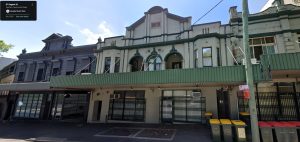
If you live in Sydney, you might be able to name a few famous pubs: The Hero, The Oaks, and Watson’s Bay. However, there is a pub that should be just as famous, and you wouldn’t know it even if you were standing in front of it. The erasure of The Empress Hotel from Sydney’s landscape is not just historical negligence—it’s an active suppression of the site where Aboriginal Australia’s modern political resistance was born, where the Black Power movement took shape, and where the idea for the Aboriginal Tent Embassy first took form.
At 85-87 Regent Street, Redfern, an anonymous apartment building stands where The Empress Hotel once operated. No plaque marks this site. No tour stops here. Yet between the 1950s and 1989, “The Big E” served as the beating heart of Aboriginal Sydney—first as a sanctuary, then as a battleground, finally as the birthplace of movements that would transform Indigenous rights across Australia.
Sanctuary in a Hostile City
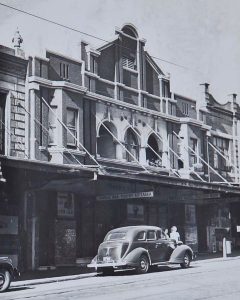
The Empress Hotel’s role as an Aboriginal sanctuary didn’t begin in the 1960s—it was already established by the mid-twentieth century. A 1949 photograph shows the hotel standing on Regent Street, already serving as one of the few Sydney pubs where Aboriginal people were permitted to drink. This was extraordinary. Throughout the first half of the century, New South Wales law prohibited Aboriginal people from drinking in public houses or even in their own homes unless they held a Certificate of Exemption—derisively called a “dog license”—from the Aborigines Protection Act 1909.
The ban on alcohol sales to Aborigines was universal and viciously enforced. When authorities briefly relaxed restrictions in 1946, they reimposed them in 1952 after a six-year “trial,” demonstrating the state’s commitment to controlling every aspect of Aboriginal life. In this context, the Empress Hotel’s willingness to serve Aboriginal patrons made it a precious establishment—one of only three such establishments in all of Sydney, alongside the Clifton Hotel and the Cricketer’s Arms.
The Big E’s location near Redfern Station was no accident—it created a powerful geographic counterpoint to one of Australia’s darkest sites. Platform One at Central Station was where the Stolen Generations arrived, where Aboriginal children forcibly removed from their families across the continent were unloaded like cargo and dispersed to state institutions. For these children, Platform One marked the beginning of lifelong trauma, the moment when paperwork was destroyed, identities erased, and connections to Country severed forever.
The Empress Hotel, just streets away, became the inverse of Platform One—a place of reconnection rather than separation, of finding family rather than losing them. Where the station platform represented the state’s systematic destruction of Aboriginal families, The Big E offered the possibility of rebuilding them.
The Post-War Migration Wave
World War II transformed Aboriginal Sydney. Wartime employment had drawn Indigenous workers to the city, and the general relaxation of movement restrictions during the war years allowed many to remain. From 1948, press articles began noting the urban migration of Aboriginal people into inner suburbs like Redfern and Surry Hills. They came for the higher wages—labour shortages meant Aboriginal workers could earn far more in Sydney than in rural areas—but they stayed for something more: freedom from the Aborigines Welfare Board’s suffocating control.
By the 1950s, Redfern was becoming what it would remain for decades: the staging post for Aboriginal people escaping what activists would later call the “concentration camp system” of government reserves and missions. The Empress Hotel anchored this emerging community, offering what the reserves never could—a place to gather without permission slips, to drink without exemption certificates, to exist without surveillance.
The Big E’s function went far beyond serving drinks. For Aboriginal people arriving from “the bush” on trains that pulled into nearby Central Station, the pub served as an information clearinghouse and a reunion point. Ruby Langford Ginibi captured its essential role: “If you had just arrived from the bush and were looking for your ‘relatives’, you’d go to the Big E, and someone would know where your people were livin’.”
This wasn’t metaphorical—it was literal survival infrastructure. In a city where rental discrimination forced Aboriginal families to squat in derelict houses, where employment discrimination limited work options, and where social discrimination meant most venues remained closed to them, The Big E provided what Aboriginal people couldn’t find elsewhere: practical information, family connections, job leads, and simple human dignity.
The pub operated as an informal postal system, employment bureau, and missing persons registry. Someone’s cousin would know about work at the railways. Someone’s aunt would have a lead on a room. Someone’s brother would know where your sister ended up after the mission closed.
The Proximity to Power and Persecution
The hotel’s location held another significance. It was located near the Foundation for Aboriginal Affairs at 810 George Street, established in the 1960s as a refuge for new arrivals and a social hub. Together, The Big E and the FAA formed a corridor of Aboriginal space in hostile territory. But geography also made The Big E vulnerable. Gary Foley noted that harassment began “the instant one left the FAA and walked toward Redfern.”
The railway industry itself—one of the first major employers of Aboriginal people in Sydney—meant Eveleigh Railway Workshops drew Indigenous workers who would stop at The Big E after shifts. The pub sat at the intersection of multiple Aboriginal geographies: the trauma site of Platform One, the employment hub of Eveleigh, the social services of the FAA, and the residential concentration of Redfern.
March 1963 should have transformed everything. The Aborigines Protection (Amendment) Act legally ended the requirement for special licenses, theoretically granting Aboriginal people the same drinking rights as other Australians. But at The Empress Hotel, regulars knew better. The law had changed; the police hadn’t.
If anything, the formal equality made things worse. Before 1963, exclusion was legal—though ugly and clear. After 1963, the persecution continued but shifted into the shadows of “drunk and disorderly” charges, “offensive behaviour” arrests, and “resisting arrest” when people questioned why they were being detained. The Big E, which had been a refuge from legal discrimination, now became a sanctuary from illegal discrimination that the law wouldn’t acknowledge.
The Gathering Storm
By the mid-1960s, The Empress Hotel was more than a pub—it was the de facto community centre for Aboriginal Sydney. Journalist John Newfong would later dub it “the cabinet room of the Aboriginal Movement,” but before it became a political headquarters, it was simpler and more essential: the one place in Sydney where Aboriginal people could gather without explanation, apology, or permission.
The community forming around The Big E included future revolutionaries who didn’t yet know they would reshape Australia. Paul Coe was just a young man having a beer. Gary Foley was fresh from the country. Bob Bellear hadn’t yet imagined becoming a judge. Ruby Langford hadn’t yet decided to write it all down. They came to The Big E for the same reason thousands of others did: because it was “our home away from home,” the one place in Sydney where they didn’t have to be anything other than Aboriginal.
What transformed these ordinary patrons into extraordinary activists wasn’t ideology or education—it was what happened next, every Thursday, Friday, and Saturday night, when the police vans began lining up outside. The Big E was about to become more than sanctuary. It was about to become a battleground.
The Pattern of State Violence
What transformed The Empress from a refuge to a revolutionary headquarters was the systematic police terror enacted there. Every Thursday, Friday, and Saturday night, the ritual began. The 21 Division—a notorious NSW Police squad formed initially to combat 1930s razor gangs—would descend on The Big E. These officers had a method, witnessed and documented by dozens:
Officers would enter and deliberately provoke confrontations, “making eyes” at women to anger their partners, pushing patrons, and inventing infractions. Then came the beatings. Gary Foley described the Empress as a “taxi rank” where police would “beat the shit out of everyone inside, arbitrarily arrest anyone who objected. When the wagons were full, they’d drive off and lock people up on trumped-up charges.”
Surrounding streets would be blocked. Paddy wagons lined up—Ted Kennedy counted eighteen on a single Thursday night in 1970. Those arrested faced the “trifecta”: assault police, resist arrest, unseemly words—charges so vague they invited police fabrication. Brutalised was Gordon Briscoe, who would later become the first Aboriginal person to earn a PhD and stand for Parliament.
This wasn’t random violence. It was systematic suppression targeting the one place where Sydney’s Aboriginal community could gather freely.
The Birth of Organised Resistance
The relentless violence at The Big E forged a generation of revolutionaries. In late 1969, young activists—Paul Coe, Gary Foley, Gary Williams, and others—imported tactics from the Black Panthers. They called it the “pig patrol.”
Armed only with notebooks and pencils, they entered The Big E during raids, documenting badge numbers, recording arrests, and building an evidence base of state persecution. The personnel realised what was happening, the confrontations intensified, but the documentation continued.
This surveillance catalysed historic developments:
The Aboriginal Legal Service (1970): Australia’s first Indigenous legal service emerged directly from planning meetings about police persecution at The Big E. For the first time, Aboriginal defendants had representation. The ALS established rosters of eminent legal observers who spent weekends in Redfern hotels monitoring police conduct.
The Black Power Movement: The shared brutalisation at The Big E politicised a cohort of young Aboriginal people who rejected their parents’ accommodationist approach. The pub became their strategy room, where American Black Power literature circulated and radical tactics were debated.
The Aboriginal Tent Embassy (1972): When Prime Minister Billy McMahon rejected land rights on Australia Day 1972, four Big E regulars—Billy Craigie, Michael Anderson, Bertie Williams, and Tony Coorey—drove to Canberra with a beach umbrella. The Embassy they planted on Parliament’s lawn had been conceived in conversations at The Empress.
The regular cast at The Big E reads like a who’s who of Aboriginal activism: Paul Coe, who co-founded the ALS; Bob Bellear, future Australia’s first Indigenous judge; his wife Kaye Bellear, who documented police tactics; Naomi Mayers, who would run the Aboriginal Medical Service; Dennis Foley, future academic; Gary Foley, Black Power leader; Ruby Langford Ginibi, writer and chronicler.
Erasure as Ongoing Violence
In 1989, The Empress was photographed as the “Regent Hotel” for a City of Sydney heritage study. Soon after, it closed permanently. The building was gutted, converted to apartments, and all identifying features were painted over. Today, nothing marks the site.
This erasure is not passive forgetting—it’s active suppression. Platform One at Central Station, where children from the Stolen Generation arrived, has received plaques and acknowledgment. The sites of the Foundation for Aboriginal Affairs, the Aboriginal Legal Service, the Aboriginal Medical Service, the Aboriginal Dance Theatre, and Murawina pre-school, all unmarked. But The Big E’s erasure stings most sharply because it was simultaneously a sanctuary and a battleground, the place where modern Aboriginal resistance coalesced from shared trauma into organised power.
Gordon Briscoe, brutalised at The Big E in his youth, reflected on visiting these unmarked sites: “The material evidence that we can talk about as part of our own healing has been torn asunder… When we try and reconstruct it we are accused of being reconstructors of fallacy.”
The Reckoning Required
The Big E wasn’t just another pub where politics happened to occur. It was the crucible where Aboriginal Sydney transformed persecution into power, where the nightly violence of the state met its organised opposition, where movements that would reshape Australia were born over beers and bloodshed.
Its current invisibility perpetuates the violence it once witnessed. Every unmarked day at 85 Regent Street extends the police raids, continues the erasure, denies the history that Aboriginal activists bled to create.
Sydney Council must act. Install a substantial plaque—not a token gesture but a proper historical marker detailing The Big E’s role in Australian history. Create a digital archive where survivors can record their memories before they’re lost. Include The Big E in official heritage walks. Consult with the Redfern Aboriginal community to determine an appropriate form of recognition.
Most urgently: acknowledge that this isn’t ancient history. Gary Foley, Paul Coe, Kaye Bellear, and dozens of Big E veterans still walk Sydney’s streets. They remember the sanctuary. They bear scars from the violence. They created the resistance. Their history—our history—stands unmarked, converted to apartments, as if it never happened.
The Empress Hotel made modern Aboriginal Sydney. The least Sydney can do is remember it existed.